The Origin and History of the Great Perfection
A Brief Overview
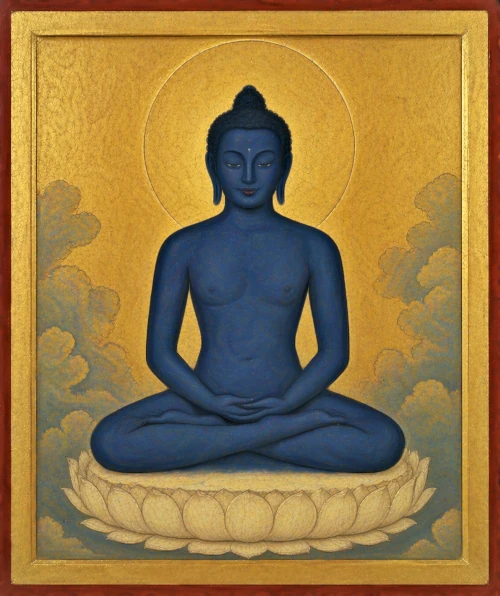
The Great Perfection (Dzogchen Atiyoga) is an ancient path of non-duality and direct realization of the Ground of Reality and the True Nature Being. It originated with the Indian Mahāsiddha Garab Dorje in the legendary kingdom of Uddiyana, showing the direct means to point the mind toward its primordial state of freedom.
This tradition arises from several strands of Buddhism and mystical contemplative movements that developed in India over 1,500 years ago. While precise dating for early masters varies across texts, the most reliable date for the founder, Garab Dorje (sanskrit Anandavajra), is approximately between the 6th and 7th centuries CE. However, some hagiographical and traditional accounts place him much earlier, as early as the 1st century.
The Dzogchen teaching emerge in the milieu of the evolution of Buddhist contemplative traditions (Yogachara), the rise of Tantric Buddhism and the yogic Mahasiddha tradition sometimes associated with the later Sahaja (the natural path) movement represented by great figures like Saraha among others.
Unlike the monastic scholasticism and the tantric ritual elaboration (or even excesses), the Sahaja movement (for lack of a better term) arises almost as a counter-culture movement, calling for the return to the pure essence of the Dharma. Rather than engaging in speculative philosophy or ritual formalities, these teachings represent the essential pinnacle of the Buddhist path. The Atiyoga (tib. Dzogchen, Sansk. Mahasandhi) teachings in particular, according to tradition, they were revealed directly by Guru Garab Dorje, the first human teacher, who received the complete transmission from Vajrasattva, the manifested nature of Samantabhadra, the Primordial Buddha or Ground of Reality.
Early Phase: The Indian Lineage
The short Indian lineage prior to the Tibetan transmission flows as follows:
Samantabhadra → Vajrasattva → Garab Dorje → Manjushrimitra → Sri Simha
Sri Simha is a pivotal figure. He passed the teachings to four key figures: Padmasambhava, Vimalamitra, Jnanasutra, and Vairotsana. It was Padmasambhava, Vimalamitra, and especially Vairotsana who introduced Dzogchen to Tibet. As Buddhism eventually disappeared from India, these teachings were preserved and further developed within the Tibetan tradition.
Scholars debate the extent to which current Dzogchen teachings and texts originated in India versus later Tibetan development. According to traditional accounts, the complete Dzogchen Tantras were collected and organized by Garab Dorje’s main student, Manjushrimitra, however that is historically doubtful. What is certain is that in the late 8th century, the Tibetan translator Vairotsana travelled to India to find Sri Simha, returning with the teachings that formed the basis of the Dzogchen view and path.
The Founding Masters
Garab Dorje (Anandavajra)
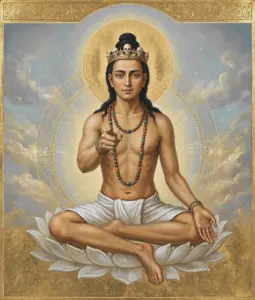
According to the traditional account, the first master of Dzogchen, Garab Dorje, was born in the Kingdom of Uddiyana to Princess Sudharma, daughter of King Uparaja. Sudharma, a Buddhist nun, dreamt of a white luminous man placing a vase marked with the mantra Om Ah Hum Svaha upon her head. Three days later, she became pregnant. Fearing judgment, she hid the pregnancy and eventually abandoned the newborn in an ash pit. Three days later, she returned to find the child alive and smiling. Recognizing his extraordinary nature, she retrieved him.
As a child, Garab Dorje displayed immense gifts, famously defeating Buddhist scholars in debate at the age of seven. He renounced palace life to meditate in the mountains for 32 years, attaining full awakening. He later traveled to Bodhgaya, where he transmitted the complete Dzogchen teachings to Manjushrimitra before dissolving into light.
A Note on Historical Identification
Modern scholarship offers a more complex, though no less fascinating, view. The identification of Garab Dorje with the 6th-century Mahasiddha Anandavajra (as proposed by A.W. Hanson-Barber) provides a historical anchor within the wider Sahaja movement, even though this remains a theory not accepted by everyone, it offers an interesting possibility that is not far fetched. While some scholars debate whether the teachings were codified later by figures like Manjushrimitra, the consensus among researchers is that these texts emerged from a distinct, counter-cultural milieu that sought to bypass the increasingly rigid monasticism of the era. This historical context is reinforced by some of the lineage accounts where Manjushrimitra—Garab Dorje’s primary student and a prominent scholar at Nalanda University – was sent specifically to defeat Garab Dorje in debate and suppress the spread of the ‘non-causal path.’ However, upon losing the debate, he recognized the truth of the teachings and became the lineage’s most vital transmitter. Historically however we do not really know much about this mysterious figure. Scholar Hanson-Barber in a large historical analysis proposes to have identified him as one of the famous Mahasiddhas of the late 6th century called Anandavajra, while others remain sceptic of this identification.
Did you know?
While often placed in the Swat Valley, the origins of the ‘non-causal path’ are deeply linked to the Sahajiya movements of ancient Orissa and Bengal—the historical heart of the Sahaja Dharma. If you are interested read my article Searching for the Ancient Kingdom of Oddiyana
Manjushrimitra
Born into a high-caste Brahmin family, Manjushrimitra became a monk and studied at the great Nalanda monastery, mastering the Yogachara tradition. However, realizing the limits of conceptual analysis, he followed a dream instruction to seek the highest realization. He traveled to the Sitavana grove near Bodhgaya, met Garab Dorje, and became his student. After Garab Dorje’s passing, Manjushrimitra compiled and organized the teachings into the Three Classes of Dzogchen Tantra.
Sri Simha
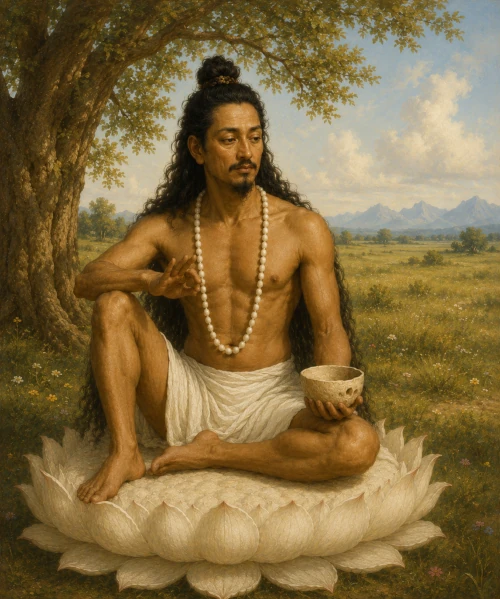
Sri Simha’s birthplace is debated, with some sources placing it in Central Asia and others in Northern India. He was a student of Haribhala. After a vision from Avalokiteshvara urging him to seek awakening in a cremation ground, he initially hesitated, spending years studying Tantras. Upon the Bodhisattva’s second appearance, he immediately traveled to the indicated place, met Manjushrimitra, received the complete transmission, and attained full realization.
According to scholar A.W. Barber, Sri Simha later moved south, residing near Lake Dhanyakataka (often identified with Lake Danakosha) in modern-day Andhra Pradesh.
The Tibetan Lineage
Vairotsana
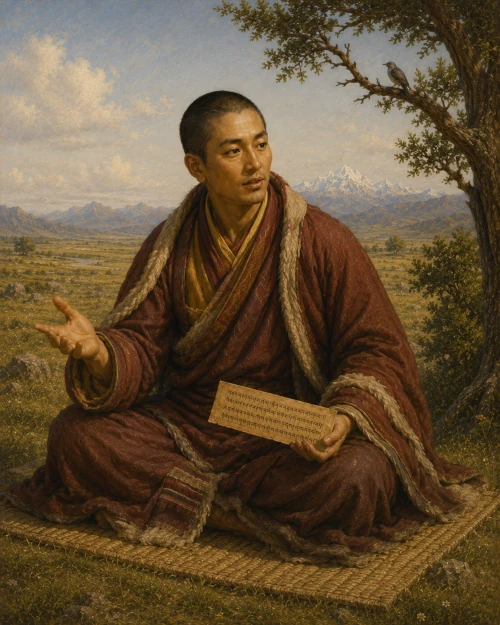
It was at Lake Dhanyakataka that the young Tibetan translator Vairotsana encountered Sri Simha. Born in central Tibet, Vairotsana was trained as a translator at age 15 and sent on a perilous journey to India to find the Dzogchen teachings. After years of searching, he reached Sri Simha, underwent intensive study, and returned to Tibet with the teachings, translating the first Dzogchen texts.
Vairotsana is the key bridge of the transmission of the Atiyoga lineage from India to Tibet. Not only was he an extraordinary translator, scholar and teacher, but a fully accomplished master of the tradition.
Upon his return to Tibet he started to teach Dzogchen and translate the first root scriptures. However his activity was interrupted due to political intrigue against the Dzogchen teachings and Vairotsana was forced into exile to the far eastern borders. He was in exile for many years until the Indian Dzogchen Master, and also a student of Sri Singha, called Vimalamitra arrived in Tibet and persuaded the ruling elite that those teachings were authentic. Vairotsana was then recalled and continued his work to translate and teach.
Later on countless Tibetan masters were crucial to the continuation of these teachings. Key figures include:
Nub Sangye Yeshe (9th Century): He produced the first known systematization of Buddhist teachings in Tibet that explicitly list Atiyoga as a unique, standalone, and complete path to full awakening.
Rongzom Pandita (11th Century): A great scholar-yogi of the early Tibetan tradition, he is credited with receiving the complete transmission of the various lineages (from Vimalamitra and Vairotsana) and teaching extensively.
Longchen Rabjam
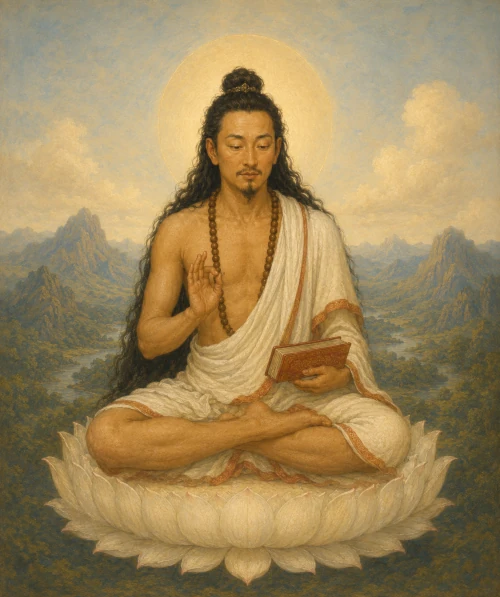
Longchen Rabjam (1308–1364): Longchenpa is without a doubt one of the most significant figures in the tradition of Dzogchen Atiyoga.
Born during the 14th century in central Tibet into a noble family, he demonstrated prodigious intellectual abilities early, reading and writing by age five without formal training.
He was ordained at Samye Monastery and studied extensively in major scholarly institutions like Sangphu Neuthok, mastering sutra, tantra, and logic from masters across traditions.
Disillusioned by the environment at Sangphu, Longchenpa left the monastic setting and sought the Atiyoga teachings under the guidance of Rigdzin Kumaradza, a wandering atiyoga master, from who he received the complete transmission and Dzogchen training. He stayed with Kumaradza for approximately two years. During this period, they lived a nomadic, ascetic life, moving frequently through the highlands of southern Tibet, where Longchenpa received the complete transmission of the Dzogchen teachings, particularly the Nyingthig cycles. After this period he settled in a hermitage (Chimphu) where he remained in retreat for seven years. After this period he travelled and gave teachings for several years, culminating in 1353 when he was forced into exile due to political persecution. He was in exile in Bhutan aproximately six years, after which he returned to Tibet to spend the last years of his life.
In addition to being an extraordinary yogi who attained the highest accomplishment, he was a brilliant scholar and writer.
He composed many crucial works, including his seminal texts, the Seven Treasuries and the Nyingthig Yabshi, which synthesized and clarified Dzogchen philosophy for future generations.
According to the traditional accounts he passed away in 1364 at his hermitage in Chimphu, his body remained uncorrupted for twenty-five days while rainbow lights arched across the sky and flowers rained down, despite it being the dead of winter signaling that he had attained the highest level according to the Dzogchen teachings.
Following Longchenpa, the lineage continued through masters such as Jigme Lingpa, Karma Lingpa, Dudjom Lingpa, and Tsokdrul Rangdrol (Shabkar), up to recent masters like Dudjom Rinpoche, Dilgo Khyentse Rinpoche, and Chogyal Namkhai Norbu.
Questions of Origin and a Shared Heritage
The Lineage of the Essence: A Synthesis
While the historical records of the early masters often drift into the luminous fog of time and hagiography, a broader view reveals a remarkably consistent “Sub-current of Immediacy” flowing through Indian Buddhism. If we look beyond the specific names and dates, we can observe a recurring structural resonance that suggests a unified contemplative movement—one that evolved its “outer clothing” to survive different cultural and religious climates.
The Continuity of the Spontaneous Way
We can suggest that the “Sahaja Dharma” manifests through three historical layers:
The Yogācāra Foundation: The 4th-century emphasis on “Direct Pointing” to the nature of mind—a lineage of insight that moved into China as Chan (Zen) before the “Tantric Revolution” fully transformed the Indian Buddhist landscape. As it says in the famous quote attributed to Bodhidharma: “A special transmission outside the scriptures, Not founded upon words and letters; By pointing directly to mind it lets one see into [one’s own true] nature and attain Buddhahood.”
The Atiyoga View: The emergence of the “Great Perfection” (as seen in the Guhyagarbha and the Semde), where the direct insight into the innate state absorbed the sophisticated symbolic language, and some methods, of the Tantras, positioning itself as the “resultant” pinnacle of the path.
The Sahajiya Movement: The 9th-century “Essence” movement of the Mahāsiddhas, which arose to strip away the emerging excesses of both scholasticism and complex tantric ritualism, returning once again to the radical simplicity of the “Innate State” (Sahaja). As Professor Giuseppe Tucci acknowledged1, the historical roots of the Great Perfection are inextricably linked to this Indian tradition—often referred to as the Sahajayāna (a modern term).
A valid and coherent thesis: these are not isolated phenomena, but a single “Lineage of Essence.” While there is no historical evidence for a single historical organization, or standalone lineage, because likely one never existed, the internal evidence—the textual echoes, the shared terminology, and the similarity in “View” regarding the non-causal nature of awakening—points to a shared contemplative milieu. This is not a search for some ‘perennial’ unifying lineage, because I do not believe there was one – but the recognition that at the highest levels of the mystical and essential spiritual path we always find this undercurrent which manifests in different forms, but essentially, says the same things.
(…) Therefore, by three sources we have placed Garab Dorje in the mid sixth-century. (…) The fact that he can be connected with what we are calling sahajayana, which later developed into the Mahamudra and Dzogchen, is an important point to keep in mind. – A.W Hanson-Barber 2
Notes:
- Reynolds, John; The Golden Letters
- Hanson-Barber, A.W. , The Life and Teachings of Vairocana