Key Principles of Dzogchen Atiyoga
This page outlines the traditional framework of Dzogchen Atiyoga as a reference for key principles and terminology. For deeper explanations, see the Dzogchen-Atiyoga chapter in the freely downloadable book Gateways to the View available in the library, along with teachings on YouTube and Zoom.
This page is work in Progress. Details and topics will be developed over time.
Current version update: 9 August 2026
Navigation
Ground, Path and Result
Ground
The primordial state of reality and being. The real nature of existence and reality. The source of all that appears whether dualistic samsara or awakening.
In brief, the Ground is Primordial Awareness, it is explained in three points:
Essence: Primordially Pure, emptiness and awareness
Nature: Luminous Clarity, spontaneous presence
Energy: All pervasive dynamic creative power – unceasingly
The three are not separate ‘parts’, they are inseparable – they are three ways that point at aspects of the Pure Ground.
Youthful Vase Body
This is a very precise and subtle term in Dzogchen. It is connected with the Ground and the wisdom essence of the Ground and how it manifests. It is not something else other than the ground, but it refers to a particular mode of abiding and manifesting. When light shines in the crystal, lights and external rainbows appear. In the same way, when circumstances arise the inner luminosity of the Ground manifests as the appearances of spontaneous presence. This ‘condition’ where the ground dwells without projections is referred as the ‘ever youthful vase body’. When the seal of the vase is broken then there is outer manifestation, sentient beings, Buddhas, samsara and nirvana and so on.
As Jigme Lingpa says:
Just like a sapphire’s inner light
A depth of luminosity that does not shine externally
Except when urged by circumstances,
The radiance of primordial purity
Transcending thing and property
Is naturally, spontaneously present.
As long as there is no breaking of the outer seal,
Its like a body closed within a vase.
Youthful because it is uncreated and unceasing. Vase because the entire manifest dimension of samsara and nirvana are contained within it without having spacial or temporal dimensions. (like a bindu). Dimension (Kaya,Form) because it is the ground for the manifestation of all the enlightened qualities and all manifestations (the three kayas, see below).
The Youthful Vase Body can be said to have six qualities:
1) Manifests its own state
The inner luminosity of the Ground is self-knowing, it appears to itself. It is not produced by something else.
2) Emerges from the Ground
Primordial Luminous Wisdom arises inseparable from the Ground and yet it is clearly distinct and Self-knowing, in that way it transcends the Ground as it arises as the spontaneously manifested 5 wisdoms.
3) It Differentiates
There is wisdom that knows the five lights as being awareness itself, so there is clear discernment.
4) Liberation through discerning
By that seeing that the five lights are the ground awareness there is liberation.
5) Does not arise from other
The YVB does not arise from something else other than the pure Ground.
6) Remains in its own place
It is not neutral – there is awakened wisdom which is inseparable from the Ground.
The Eight Gateways of Spontaneous Presence
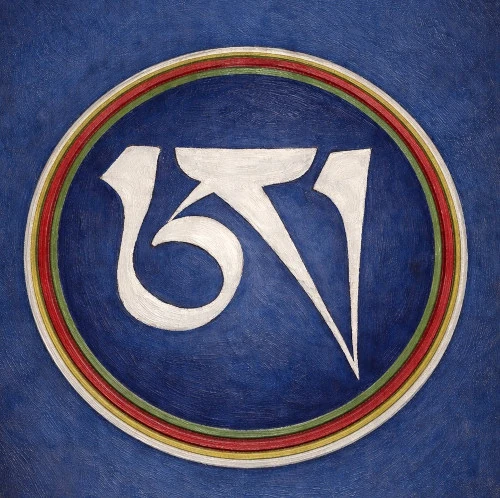
This explains how the ground manifests as appearances, either pure or impure (samsara).
1) Compassion/energy: the unceasing creative power of the Ground
2) Radiant Display: The Five lights arise within the Ground
3) Appearances arising as primordial wisdom – Self-knowing wisdom
4) Appearances arising as the Perfect Pure Forms (enlightened kayas)
5) Appearances are non-dual in relation to the Ground
6) Appearances arise beyond extremes of existing or non-existing, inside or outside, free from concepts.
7) The First Door: awakening – because awareness is non-dual if the lights and appearances are recognized as non-dual with the ground it is the door of awakening
8) The Second Door: Delusion – as arising is unceasing, non-recognition is the appearance of dualistic samsaric experience
In short, in relation to these previous aspects of the Ground – From the natural and spontaneous clarity and energy of the ground manifest unceasingly the five lights and five rays within the pure dimension of the Ground. If the intrinsic knowing power of the Ground recognizes the appearances as self-display, then that is liberation and primordial awakening. If they are not recognized due to ignorance (see the three modes of ignorance below) then duality arises as subject and object in relation to the ground and its displays, and that is samsara.
Three Modes of Ignorance
1- Ignorance that has the same nature as awareness
2- coemergent ignorance
3 – Conceptual ignorance
The moment that appearances arise in the natural ground, then at the same time, arises also as a clarity and knowing that can examine. This examining cognition, which is the same as the nature of awareness, does not recognize itself as being the same as awareness, and so it is ignorance that has the same nature as awareness. As this arises, the examining cognition also arises, this is called co-emergent ignorance. When this examining cognition is not recognized as clarity of awareness, but instead the appearance is seen as something ‘other’ and separate, this is conceptual ignorance.
Path
Three Statements of Garab Dorje
The path is explained through the Three Statements of Garab Dorje which include the essence of the Dzogchen path:
1) Direct Introduction: Recognizing our own intrinsic awareness, our own natural conditioned
2) Deciding beyond doubt: Having no doubt that there is nothing to know other than our own intrinsic awareness and there is nothing separate from it (or clarifying the doubt that remains from the first point)
3) Confidence in Liberation: Allowing thoughts and appearances to liberate themselves into the natural state.
The Path is further elaborated as View, Meditation and Conduct.
View, Meditation and Conduct
View: The intrinsic awareness that was recognised (see above)
Meditation: habituating ourselves in remaining in that awareness that was recognised.
Conduct: Integrating this awareness in all daily activities
Foundational Practices
The special methods of separating mind from awareness (rushen) and facilitate the recognition of intrinsic awareness. There are several methods categorized usually as:
Outer, Inner and Secret connected with Body, Speech and Mind.
The Four Contemplations of the Essence of Mind
1) Contemplation of the empty mind (calm state)
2) Contemplation of the non-movement of presence
3) Contemplation of the sameness of movement or non-movement
4) Contemplation of Spontaneous presence
The Contemplation of Cutting-Through, or Leaving things Free in their own state (Treckcho)
The Natural way of resting in pure awareness in order to realise the pure Ground.
a) View: Leave it like a Mountain
b) Meditation: Leave it like the Ocean
c) Movement: Leave it in Natural Awareness
d) Appearances: Leave it be of Appearances
Essence: Having decided clearly upon the view of intrinsic awareness, rest, do not correct, do not fixate, do not reject, do not strive – leave everything in the natural simplicity of the natural condition.
Experiences During the Path
There are different ways to explain the different experiences as a practitioner deepens their stability and realization. A general explanation of the experiences in meditation which also has several variants, the stages of experience from the practice of Cutting-Through (Four visions of Cutting-Through) and the Four Visions associated with the practice of Leap-over (In this page the practice/points related to Leap-over are not presented).
General Experiences in Meditation
a) liberation upon observation – awareness placed on the thought and it disappears – like dewdrop vanishing under the sun.
b) Liberation upon arising – As soon as a thought/emotion arises, it liberates itself, like snow falling in the ocean.
c) non-dual self-liberation – the illusion of the dualistic vision of self and object disappears. There is nothing to liberate and no-one liberating anything.
Alternatively:
a) Like a Snake untying its own knot – Thoughts release themselves by leaving them be
b) Like writing on water – Thoughts arise and dissolve with minimal disturbance like drawing on water
c) Like a thief entering an empty house – awareness is unconditioned by any movement, there is no problem – like a thief entering an empty house
Stages Experienced in Cutting-Through
1) Great Vision of the Direct Experience of The Nature of Reality
The direct realization of intrinsic non-dual pure awareness
2) Vision of Increase in Experience
By the development of confidence in the single nature of pure awareness there is an increase in experience where all is liberated, nothing to reject, nothing to accept, arising of bliss, inherent qualities of the primordial condition start to manifest in many experiences.
3) Vision of Perfection of Intrinsic Awareness
There is no difference between meditation or no meditation. Primordial awareness is like a continuous river and many qualities manifest.
4) Vision of the Dissolution into the Nature of Reality (dharmata)
Transcending all attachments and aversions, dualism, self-grasping and ignorance everything is self-perfected. All fixation on internal or external having dissolved into the natural condition the form bodies dissolve into the great expanse.
The Result
The result is realization of the Ground. There was never any delusion or samsara to begin with. Ignorance itself is not really existent.
The result can be seen as the realization of
1) Dharmakaya: the luminous and empty essence of reality endowed with perfect qualities of wisdom, clarity and compassion
2) Sambhogakaya: realization of the luminous manifest nature of compassion.
3) Nirmanakaya: Realization of the unceasing compassionated energy that manifests infinitely.
Other Principles
The Five Aspects of Samantabhadra
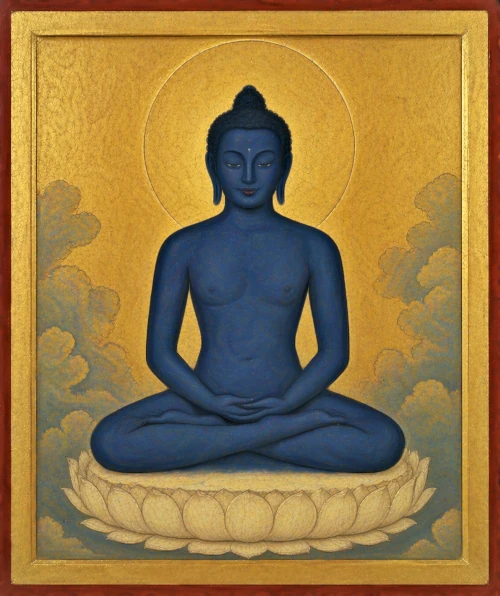
Samantabhadra as the Primordial Buddha is considered in five manners. Samantabhadra as:
1) Primordial Teacher – The Dharmakaya itself, the compassion energy of the ground is the actual root teacher of all teachings, it is the source of all liberating teachings.
2) Adornment – The Pure authentic Dharma teachings is Samantabhadra as ornament
3) Path – the pure path as in the fact that the result is present naturally. This is not the path as a cause for a result, but path as the nature of reality that is present.
4) Pure Awareness – The Pure awareness that the practitioners relies upon on the path
5) Realization – The realization of the Pure Ground is Samatabhadra as the Ground and Realization of the Ground
The Four Modes of Abiding
These are the four inherent modes of abiding of the Ground. They are also commonly known as the four Samayas of Dzogchen.
1) non-thing – The primordially pure nature of the ground and all appearances – emptiness or no-thingness – phenomena appear but are beyond any conceptual designation or fixed essence.
2) Pervasiveness (all-pervading) – The natural state, the Ground, is omnipresent, it pervades all phenomena without differentiation.
3) Non-Duality – Appearances are inseparable from the pure awareness/clarity of the Ground
4) Spontaneous Presence – All perfected qualities are already present in the Ground, there is nothing new to create.
The Five Wisdoms
In relation to Dzogchen and the Five Lights mentioned above:
1) Dharmadhatu Wisdom – The wisdom that knows the true nature – All pervading Space – Blue light
2) Mirror-Like Wisdom – Wisdom of clear display, clarity – White Light
3) Sameness-Wisdom – Wisdom that knows the evenness of all appearances within basic space – Yellow Light
4) Discerning Wisdom – Wisdom that discerns clearly all manifestation – Red Light
5) All-Accomplishing wisdom – Wisdom that manifests unobstructed compassionate activity – Green Light
Conversely – If the non-dual true nature of these are not recognized, then they manifest through the door of Samsara as:
1) Ignorance – relative space
2) anger/aversion – water element
3) Pride – Earth element
4) desire/attachment – Fire element
5) jealousy/envy – wind element