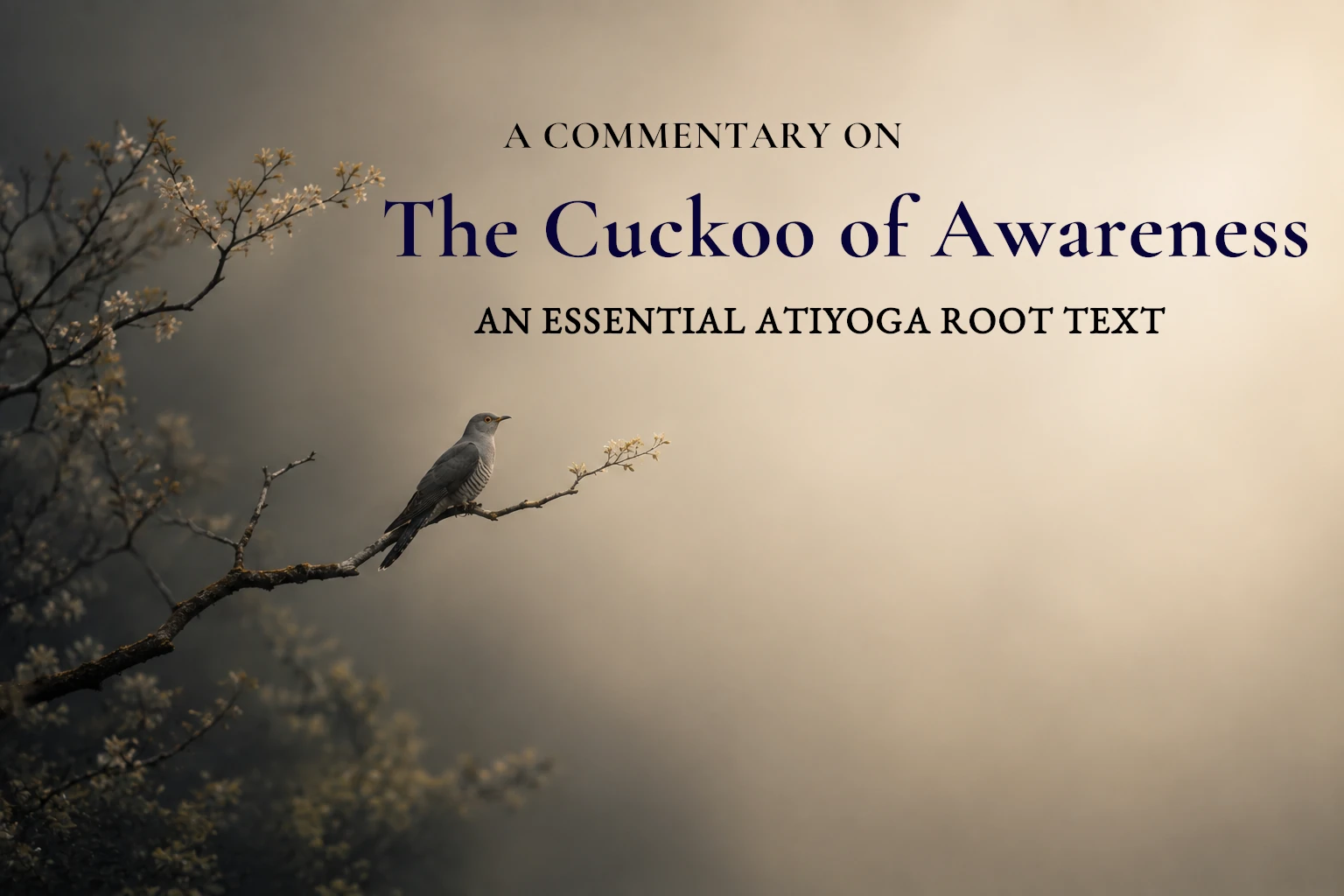
The Cuckoo of Awareness
Explanation of this fundamental Root Tantra of Dzogchen
In this page there is complete teaching on this fundamental Atiyoga text. There is a video teaching which is 45 min summary of the meaning. Below you find an extended text explanation.
The Cuckoo of Pure Awareness
- The nature of the infinite variety of phenomena is without duality,
- each thing in itself (singularity) is beyond all concepts and limits of the mind.
- The natural condition, suchness as-it-is, is beyond concepts about anything,
- yet the radiance of Samantabhadra manifests as all diversity of form
- All is self-perfected in actuality, so liberate the sickness of effort,
- remain free and natural in spontaneous total presence.
Video Teaching (shorter explanation)
Click Thumbnail to open on youtube
Longer Explanation in Commentary form
Introduction
The Cuckoo of Awareness is a very ancient text. According to tradition this was one of the first root texts of Atiyoga that Vairotsana brought from India, one of the five root texts of the Essence of Mind. Even though it is very short it contains the complete meaning of the Great-Perfection. The fact that this text is very ancient is beyond doubt because manuscripts of this text were found in the Tun’huang caves. The caves were sealed in the late 10th century, and only accidently reopened in the early 20th century and inside a vast cache of ancient texts was discovered which is still being analysed until today. This text is also included in the major Atiyoga Tantra ‘The All Creating King’ (kulayaraja tantra), attesting to its significance.
As for the title, this text is in fact known by different names. A very common name for this text is simply ‘The Six Vajra Verses’, also ‘Ornament of the Appearance that Brings one to Realization’.
As for the meaning of the Cuckoo it is usually explained that just as the Cuckoo’s song announces the end of winter and the coming of spring, in the same way this text announces the end of ignorance and the dawn of wisdom. One other way to consider it is that the song of the Cuckoo is very distinct and clear and it raises itself above all other birds, just as the teachings of Atiyoga are pristine, clear and cut through all intellectual or contrived fabrications regarding reality.
This text has six verses, which are to be understood two verses at a time, that is, three sections with two verses each. In many traditional explanations we will see these three sets mapped onto the Ground, Path and Result of Dzogchen, or the View, the Meditation and the Conduct. However the text itself as it is offers a unitary view of the Great-Perfection.
The Ground, Path and Result
When we present the Atiyoga teachings as Ground, Path and Result it seems to imply there is a gradual progression. But that is not the case. The separation into these three aspects its only functional and pedagogical from the perspective of a sentient being entering this path. In order to understand the unitary nature of these aspects I will explain them briefly from this point of view. So what is the Ground? The Ground refers to the actual condition of reality as it is, which in this sense is the basis of all that appears, whether awakening of deluded samsaric appearances. It is the infinite, primordially pure, luminous great expanse – it is Primordial non-dual Awareness. Primordial non-dual awareness is the Ground of Being and the Ground of reality. It is called the Ground because it is the source of all that appears. So if the Ground is intrinsic non-dual awareness, why do beings experience the dualistic, samsaric existence? The dualistic samsaric existence arises due a factor of unknowingness, usually referred as innate ignorance. The natural clarity of the ground’s displays appears to form a cognitive veil whereby the natural cognitive power of awareness fails to know that these displays are awareness itself. From this moment arises a form of unknowingness which arises together with the natural liveliness of the Ground failing to recognize these movements as itself, thereby objectifying them. At this point gross duality manifests as subject and object. Due to this manifestation of illusion of subject and object (maya), sentient beings appear and seem to be deluded. For that reason we speak of teachings and path to realize our real nature – that is the Path. But this path is based upon the recognition of awareness, which is itself the Ground. And the attained result is the realization of the Ground as the true nature. So in this way even though we speak of these three, ultimately they are not different, and any appearance of a gradual progression is itself part of the illusion.
In short, The Ground is the basis of all reality as it is, not being known, we call it the Ground. Once primordial awareness is recognized, that is the Path. Once the full realization of the true nature manifests, then it is called the Ground as the Result. A good example for this is the Sun. The Sun is always present and complete in itself. From the point of view of beings on earth, the Sun seems to move, to become dimmer, then it disappears, then it reappears again. But the Sun itself never changed.
Explaining the Root Text
The First two lines:
- The nature of the infinite variety of phenomena is without duality,
- each thing in itself (singularity) is beyond all concepts and limits of the mind.
The Infinite variety regards to the many different visions that appear. In simple terms it means all the phenomena that can appear. They can be called ‘visions’ because everything appears as a vision to mind, in the sense of ‘appearing to mind’. The first line says that all the infinite variety is without duality. As Longchenpa writes in the Treasury of the Way of Abiding:
Just as dreams do not stray from sleep
and, even as they appear, are by nature ineffable,
the world of appearances and possibilities, whether of samsara or nirvana,
likewise does not waver from the scope of awakened mind
and has no substance or characteristics.
and in his commentary to that same text:
None of the reflections in a mirror can occur apart from its surface;
if you examine them, no forms exist, only the surface of the mirror.
Inwardly, conscious thoughts—which arise, remain,
and are freed—do not stray from the scope of awareness; this is
analogous to waves on the ocean that arise, remain, and cease, yet are
not apart from the water.
In this way its clear that all the diversity that appears is non-dual in the sense of being of the same nature as the Ground, and inseparable from the Ground as in the examples above.
It is important here to make a clear point regarding the status of the Ground – that is, this non-duality does not mean a ‘Oneness’ in a strict sense. The Ground is not an entity. The essence of the Ground is primordial purity which is beyond all extremes – beyond being or non-being, beyond existence and non-existence, beyond one or two – it is beyond all elaboration.
The second line – “each thing in itself (singularity) is beyond all concepts and limits of the mind.”
That is to say that each thing that appears in its singularity, in its appearing, its beyond all conceptualization. It is like a mirage. A mirage appears clearly – in the sense we see water appearing in the distance. That water appears distinctly. However, what is the nature of that water? We cannot say – because there is no water there even though it appears. All phenomena are like this. If we see some object like for example an apple. In reality everything about ‘apple’ is a mere mental designation, which has no basis outside a mental concept. Whatever is that appearance which we call ‘apple’, it appears, but what is it exactly and what is its nature? That is the meaning of beyond all concepts and limits of the mind. It is the same as reflections in a mirror. Reflections appear in a mirror, but what is there? Is there some thing objectively there? The nature of that reflection is beyond concept. The moon reflected on water – is that the moon or is it not the moon? we cannot say either way.
The Ground of reality is primordially pure – that means that it is beyond being or non-being, it is not a thing, it has no fixed essence. But this is not like a nothingness because the ground is also pure awareness and infinite creative potential. It is due to spontaneous clarity of the infinite potential that all the diversity manifests within the pure dimension of the Ground. All that appears in the infinite diversity is the natural spontaneous creative power of the Ground; Inseparable from the Ground, and yet appearing without any independent essence. This resumes the meaning of the first two lines.
As for the second pair:
The natural condition, suchness as-it-is, is beyond concepts about anything,
yet the radiance of Samantabhadra manifests as all diversity of form
These two verses are pointing to the natural state, the primordial condition. This essentially is pointing to the view of natural awareness, or the natural state.
The first teacher of Dzogchen, Garab Dorje, summarized the Atiyoga path in three statements:
- Introducing Directly Mind’s Nature
- Remove all doubts about the single nature
- Integrate all into the single nature
In this way it becomes clear that these two lines are referring to the natural state, to the recognition of one’s real nature.
These three points summarize and also show what Atiyoga is as a path. In this way we understand that the beginning of Atiyoga is recognition of our intrinsic awareness, which is the nature of the mind. In this sense we start by understanding the difference between ‘normal mind’ and the ‘nature of mind’. That which we call mind is that which appears in the dualistic experience of subject and object. It is that which thinks and moves after thoughts, feelings and appearances. This ‘mind’ is illusory, like a mirage. The real nature of this ‘mind’ is intrinsic awareness. At first this is recognized as a pure presence which is beyond subject and object, beyond thoughts or no thoughts – that is called ‘path awareness’ because it is this presence that is applied in meditation. It is not yet the full realization of the Ground’s luminous primordial state, but it is also not something else. So we call it ‘path awareness’.
The second verse now points at something really very important. Even though the Ground awareness is empty of being an entity or a thing, it is not a voidness. It is also pure clarity and energy that manifests as the pure compassion of the Ground. In simple terms, all that variety that appears, it is the energy display of the Ground – and because this energy is compassion it is the radiance of Samantabhadra. Why is it compassion? Because as the Ground is primordially pure and spontaneously present in all perfected qualities, all that arises from it is perfect. In that way, all appearances are an expression of compassion.
The Ground seems like a very dead word. But here its important to understand that the Ground is not some abstract, amorphous principle. The Ground is the spontaneously awakened wisdom nature of reality itself, and that is pure awareness with all the awakened pure qualities.
In the All-Creating-King Tantra, the main Tantra of Atiyoga, it says:
Then the supreme source, pure and total consciousness, explained that all phenomena arise from his essence, nature, and energy. From his single, total, self-arising wisdom manifest the five great wisdoms (…) These five natural wisdoms give birth to the ornamental causes of the five great [elements]'”‘ and this gives birth to the three worlds subject to destruction. […] Then the supreme source, pure and total consciousness, explained that he himself is the primordial womb whence all phenomena originate (…) Without me, no teaching or assembly of disciples would ever have appeared. Sattvavajra, have no doubts! You yourself, great being, are an emanation of my nature.
This was a brief explanation verses 3 and 4. Then it continues…
All is self-perfected in actuality, so liberate the sickness of effort,
remain free and natural in spontaneous total presence.
The 5th verse opens clearly with the statement that all is self-perfected in actuality. All is self-perfected because as explained in the previous verses, all is of the nature of suchness, which is inseparable from the pure Ground. In this sense all extremes of that arise from conceptualization, such as existence and non-existence, good and bad, high and low, arising and ceasing and so on, are without any real existence. This is not to say that there is a relative reality where things exist and a ultimate reality where things have no nature. That is not the Atiyoga view. It is like the example used by Rongzonpa – consider a fire brand. When the fire brand is made to circle very fast we see a fire wheel. If we see the fire wheel we do not see the fire brand, and if we see the fire brand we cannot see the fire wheel. In reality there is no fire wheel. The fire wheel is an illusion. So in that way any leftover duality between relative reality and ultimate reality collapses into the Great-Perfection.
Important note: Many Atiyoga root tantras are written in the first person, such as “I the Supreme Source”. It is important however to understand the real meaning. These texts are presenting the highest view from the perspective of the Pure Ground. For that reason they are spoken as if the Ground is speaking. This should not be mistaken as if the Ground is an entity – the Ground is not an entity or a Being. This Ground should not be anthropomorphised. The Ground is beyond Being and non-Being. It is important to understand clearly what the intended meaning is. On the other hand the Ground is not some abstract, inert void. The Dzogchen view is subtle and profound, and careful understanding is required.
In the All-Creating-King Tantra it says:
I am the oneness of the fundamental condition, and precisely this is the reality of all phenomena: there is only me, pure and total consciousness. (…) [I am self-arising wisdom that has existed from the beginning:]”‘ “I” means the essence, the fundamental nature of all phenomena. “Wisdom” refers to the fact that, being uninterrupted and unhindered, [this nature] clearly discloses all phenomena. Its being “self-arising” means that, as it is free of causes and conditions, it transcends all effort. (…) “Pure” means that pure and total consciousness, the true essence, is self-arising and has always been completely pure: consequently, all that manifests from the supreme source keeps its purity whole in the condition of Samantabhadra. “Total” means that self-arising wisdom, the true essence, permeates and pervades the whole animate and inanimate universe, all circumstances and forms of existence, the Buddhas of the three times, the three worlds, the six classes of beings, and all possible situations. “Consciousness” means that self-arising wisdom, the true essence, dominates and clearly perceives all the phenomena of the animate and inanimate universe. This self-arising fundamental nature, not produced by causes and conditions, governs all things and gives life to all things.
Once we realize this pure non-dual path awareness, to simply remain in that condition as it is, without changing anything, it is to liberate the sickness of effort and to remain free in the natural and spontaneous total presence.
What means the sickness of effort? The sickness of effort is the belief that we, ourselves, as a self, a doer, we must do something to reach awakening, to reach happiness, to reach peace. Its the belief that happiness, peace, realization, awakening is reached by doing something. Like in a process of cause and result. This is the sickness of effort. It is a sickness because its an idea based on ignorance of our real condition, ignorance of the self-perfected nature.
So what about Karma? We cannot deny karma at the level of dualistic experience. From the point of view of Atiyoga its important to understand what this means.
Due to the arising of confusion and ignorance as explained in the first part of the text, the duality of subject and object manifests. From that innate ignorance a veil of confusion appears to form, and due to that all the actions which are done with body, speech and mind, that are based on duality, become an habitual imprint at the level of the ignorant basis. From this arises the experience of consciousness of a sentient being – whether human or some other type – and with that consciousness arises the full dimension of existence which includes the law of causality. The law of cause and effect functions in accordance with the mode of consciousness. That is to say, for example, if human beings do not have air to breath they suffocate; however if fish are left in the air, out of water, they suffocate – so we can understand that even though causality functions, the way it functions depends on the mode of consciousness. All of this experience can be simply called karmic vision. Karmic vision is the experience of existence of a sentient being, and that includes the rules of cause and effect within that particular karmic vision experience. In this case, while there is this experience of karmic vision, then the principle of cause and effect is fully functional and unfailing. For that reason we respect the principle of Karma. In this sense, actions which are positive will lead to happy and positive states, and actions that are negative lead to suffering and negative states. It is however important to notice that both of these are still limited states of karmic vision. Also it is important to note that positive karma does not produce awakening, or the qualities of awakening because those qualities are inherent to the spontaneous pure clarity of the Ground. Even though positive actions are not a direct cause for awakening or the enlightened qualities, they function as a supportive condition. That is because if we have a virtuous mind that is driven by kindness and positive actions the force of self-grasping will naturally diminish, and our conditions will be more conducive to discover and apply the teachings that lead to liberation.
Having understood this important nuance regarding karma, the text says to remain beyond effort, free and natural. This can refer to meditation and also on how we integrate our daily conduct into our practice. In both cases this is the approach. However its important to remain grounded and apply the path in a concrete manner and not allow these teachings to remain at an intellectual level. It is important to clearly understand what it means to enter into a state of contemplation and what the view is. Once we have some clear recognition of intrinsic awareness, then the meditation is simply to let our condition remain in that state without falling into dualism and distraction. This is the meaning of remain free and natural in spontaneous total presence. That also means that we try to integrate that condition in all aspects and situations. This is very important. Whether walking, eating, working etc. In this way we gradually habituate ourselves to remain in that condition of pure awareness. This is usually difficult at the start but with recollection, repetition and habituation, it becomes easier. In any case, if we don’t know exactly what it is the state of pure awareness then there is nothing to integrate yet. So at this point, we can simply try to be present in a normal way. We simply do our best not walk around distracted, but to be present in the normal way. Then when we discover our state of intrinsic presence integration will also become easier. So this means to go beyond effort. Because it is a natural condition. This is the essence of Dzogchen.
May this bring benefit.
Aja